Monthly Recurring Revenue (MRR)
If you run a membership site, MRR is probably the most important number you’ll ever track. It tells you exactly how much money you can expect to come in every month from your subscribers. Not one-time purchases. Not annual totals divided by 12. Just the predictable, recurring revenue that hits your account month after month.
Don’t be sad if MRR sounds confusing right now. By the end of this article, you’ll understand it better than most membership site owners.
What is MRR?
Monthly Recurring Revenue (MRR) is the total amount of predictable revenue your membership site generates each month from active subscriptions.
Here’s a simple example. Say you have 50 members paying $20 per month. Your MRR is $1,000. That’s it.
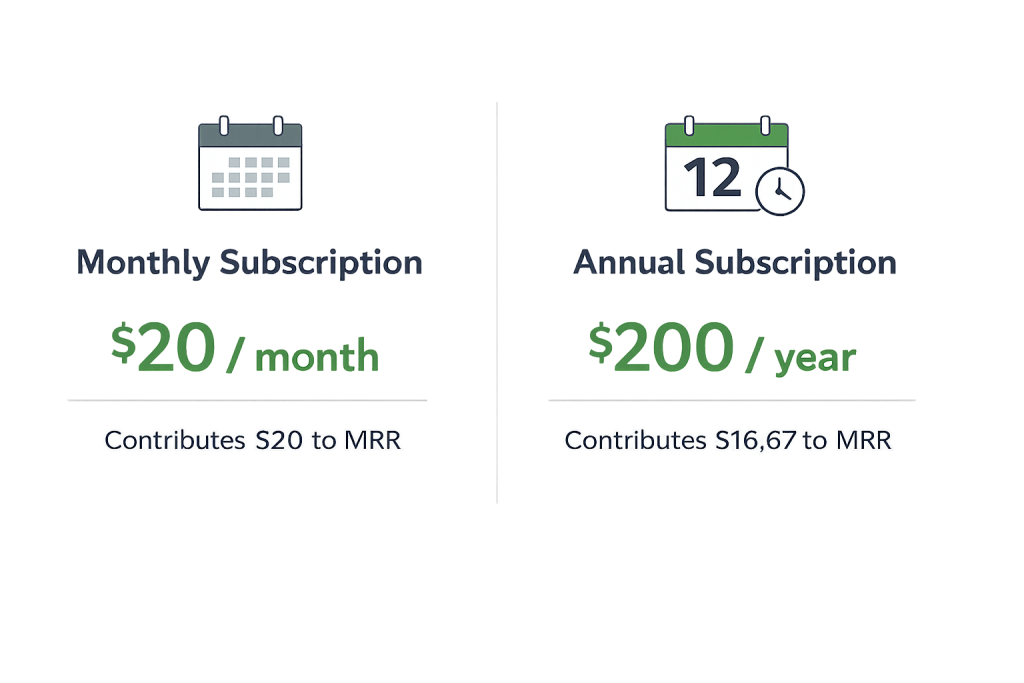
But what if some members pay annually? You normalize it to a monthly figure. So a member paying $200 per year counts as $16.67 per month toward your MRR ($200 ÷ 12).
How to Calculate MRR
The basic formula is:
MRR = Number of active subscribers × Average revenue per subscriber
For most WordPress membership sites, it gets a bit more complex because you probably have multiple membership tiers. In that case:
MRR = (Tier 1 subscribers × Tier 1 price) + (Tier 2 subscribers × Tier 2 price) + …
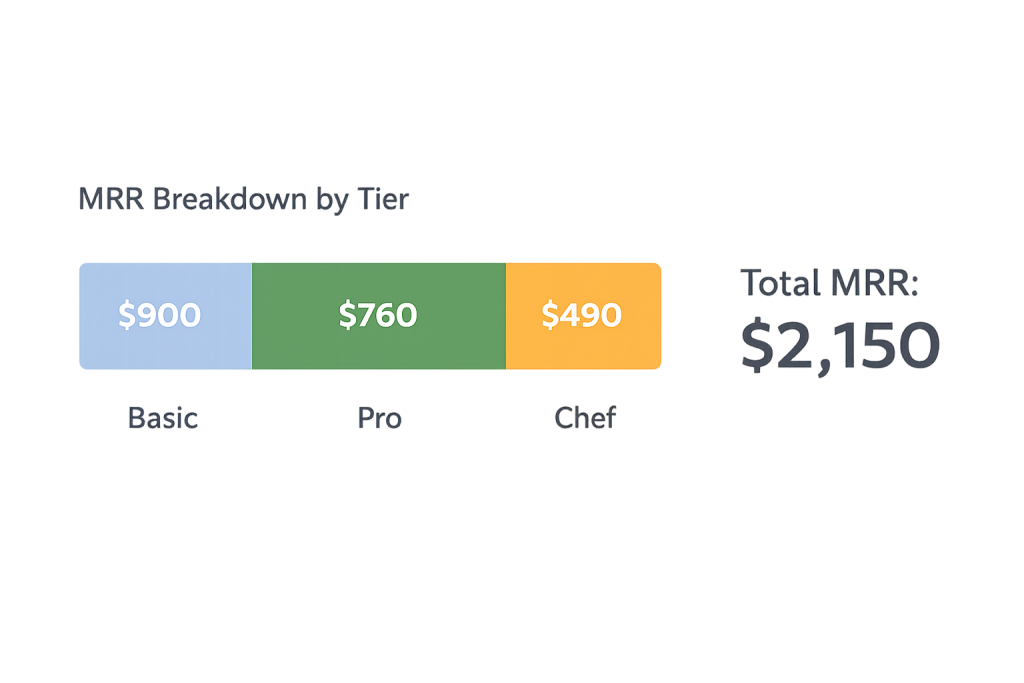
Let’s say Sarah runs a yoga membership site similar to Yoga With Adriene, but with paid tiers. She offers three plans:
- Basic: 100 members at $9/month = $900
- Pro: 40 members at $19/month = $760
- All Access: 10 members at $49/month = $490
Sarah’s total MRR is $2,150.
Now Sarah knows exactly what revenue to expect next month. No guessing. No hoping. Just a clear number she can plan around.
Why MRR Matters for WordPress Membership Sites
MRR gives you clarity. When you know your MRR, you can:
Predict cash flow. You know roughly what’s coming in next month, which makes planning easier. No more crossing your fingers at the end of each month hoping the numbers add up.
Spot trends early. A dropping MRR signals trouble before it becomes a crisis. If Sarah notices her MRR slipping from $2,150 to $1,900 over two months, she can investigate now rather than panic later.
Measure growth accurately. Revenue spikes from one-time promotions can mask real performance. MRR strips away the noise and shows you what’s actually sustainable.
Make confident decisions. Should you invest in that new plugin? Hire a VA? Upgrade your hosting? MRR tells you what you can actually afford without putting your business at risk.
Take Pat Flynn from Smart Passive Income. He’s talked openly about tracking MRR across his membership communities. It’s how creators at his level know whether they’re actually growing or just having a good month. The difference between a $10,000 month and $10,000 MRR is massive. One is luck. The other is a business.
If you’re using MemberPress, Paid Memberships Pro, Restrict Content Pro, or any other WordPress membership plugin connected to Stripe or PayPal, your MRR is sitting in your data right now. You just need to pull it together.
MRR Components: The Full Picture
Once you understand basic MRR, you’ll want to dig deeper. MRR isn’t just one number. It moves. It has parts. Understanding those parts helps you see what’s actually driving your revenue.
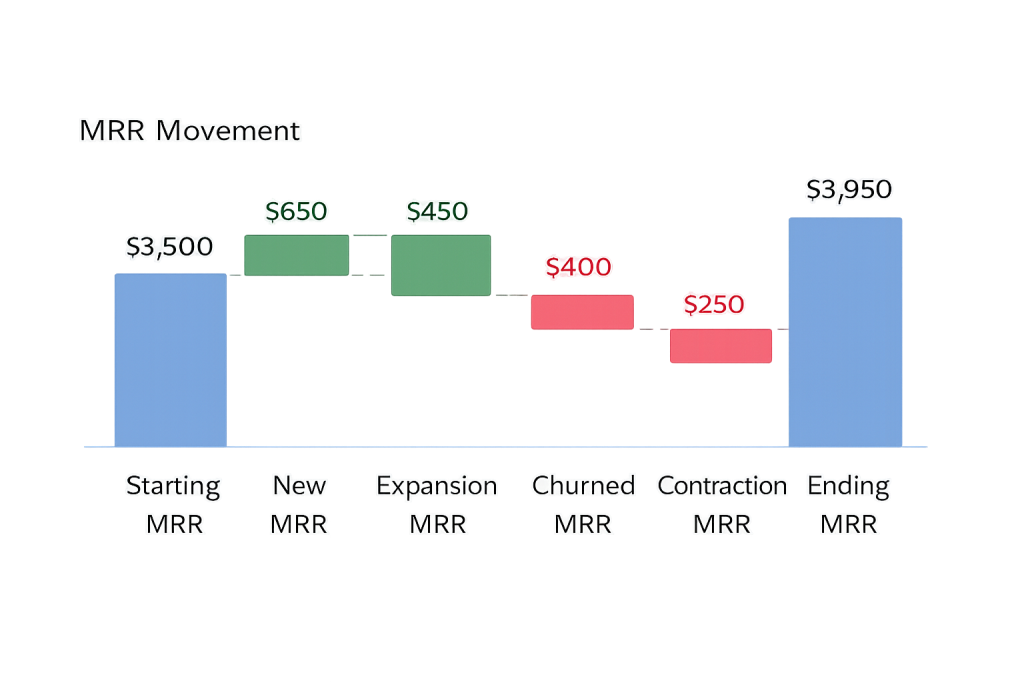
New MRR: Revenue from brand new subscribers this month. Sarah signed up 15 new members in January. Their combined monthly value is $180. That’s her New MRR.
Expansion MRR: Revenue from existing members who upgraded. Three of Sarah’s Basic members moved to Pro, adding $30 in monthly revenue. That’s Expansion MRR.
Churned MRR: Revenue lost from cancellations. Five members cancelled their $9 Basic plans. That’s $45 in Churned MRR. Not fun to look at, but tracking it is the first step to fixing it.
Contraction MRR: Revenue lost from downgrades. Two Pro members dropped to Basic, reducing monthly revenue by $20.
Net New MRR: The final picture. Take New MRR plus Expansion MRR, then subtract Churned MRR and Contraction MRR.
For Sarah: $180 (new) + $30 (expansion) – $45 (churned) – $20 (contraction) = $145 Net New MRR
Her business grew by $145 in recurring revenue this month. Not bad.
Common Mistakes
Counting one-time payments. That $500 course sale feels great, but it’s not MRR. Only recurring revenue counts. Mixing the two gives you a distorted view of your actual business health.
Forgetting failed payments. A subscriber whose card declined isn’t really active. Don’t count them until payment clears. This is one of the most common ways membership site owners accidentally overstate their MRR.
Ignoring annual normalization. If you count a $240 annual subscription as $240 MRR, you’re overstating by 12x for that month. Always divide annual payments by 12.
Not tracking MRR components. Knowing your total MRR is good. Knowing that your Churned MRR is climbing while New MRR stays flat is better. That’s actionable information. Total MRR alone can hide problems until they’re too big to ignore.
Real World Benchmarks
So what’s a good MRR? It depends entirely on your niche, pricing, and goals. But here are some reference points:
- A solo creator with a small audience might target $1,000-5,000 MRR as a meaningful side income.
- Full-time creator businesses often aim for $10,000-30,000 MRR.
- Larger membership sites like Copyblogger or Nerd Fitness operate at $100,000+ MRR.
The number itself matters less than the direction. Growing MRR means a healthy business. Flat or declining MRR means something needs attention.
No need to feel sad if your MRR is lower than you’d like. Everyone starts somewhere. The point is to know your number, understand what moves it, and track it consistently. That awareness alone puts you ahead of most membership site owners.
Track Your MRR Automatically
Calculating MRR manually works when you have 20 members. At 200 or 2,000, it becomes a spreadsheet nightmare. And manually tracking MRR components? That’s a full-time job.
We built Sad Subscription Analytics to solve this. It’s a WordPress plugin that connects to your payment provider and calculates MRR automatically. New MRR, Churned MRR, Expansion, Contraction. All of it. No spreadsheets. No guessing. Just clear numbers so you can spend less time calculating and more time growing.
Because understanding your MRR is the first step to making it less sad and more impressive.