Annual Recurring Revenue (ARR)
If you’ve got a handle on MRR, ARR is the natural next step. It’s the bigger picture view of your membership revenue. The yearly snapshot that tells you where your business stands and where it’s heading.
Don’t be sad if you’ve been ignoring ARR until now. Most membership site owners focus on monthly numbers. But understanding ARR opens up a whole new perspective on your business health.
What is ARR?
Annual Recurring Revenue (ARR) is the total predictable revenue your membership site generates over a 12-month period from active subscriptions.
The simplest way to think about it: ARR is your MRR multiplied by 12.
If your MRR is $2,000, your ARR is $24,000. That’s the annualized value of your current subscriber base if nothing changed for a full year.
For members who pay annually, you count their full payment toward ARR directly. A member paying $200 per year contributes $200 to your ARR. No conversion needed.

How to Calculate ARR
The basic formula is:
ARR = MRR × 12
That’s it for the simple version.
But if you want to be more precise and you have a mix of monthly and annual subscribers, you can calculate it directly:
ARR = (Monthly subscribers × monthly price × 12) + (Annual subscribers × annual price)
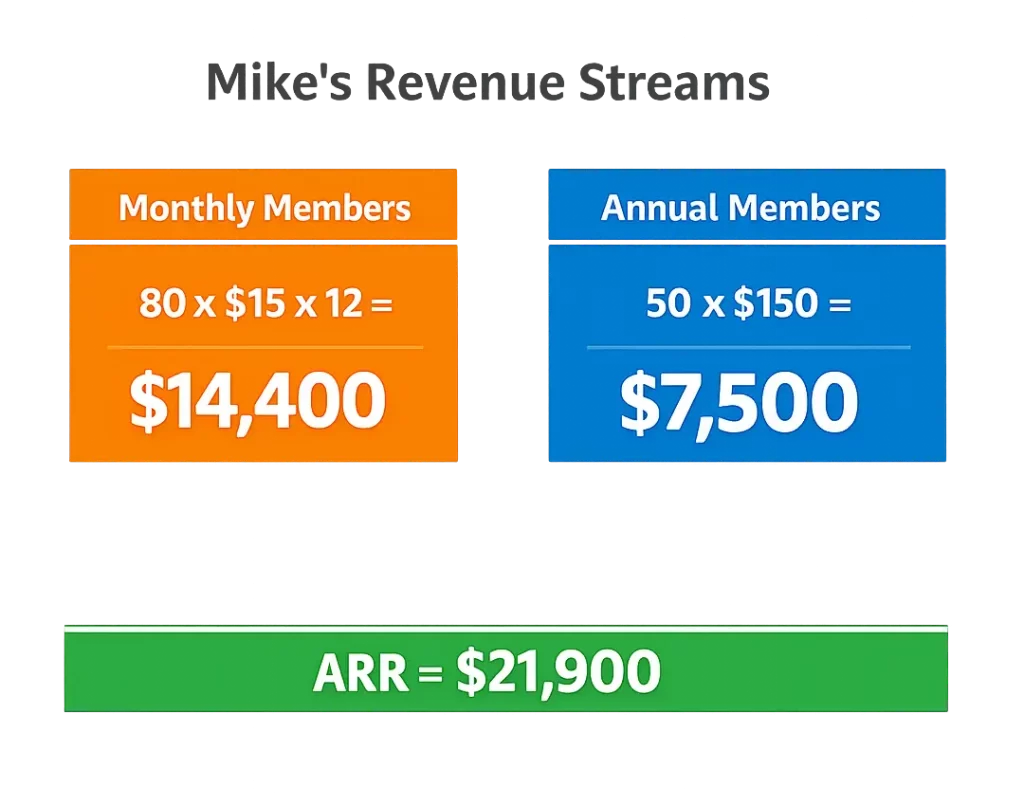
Let’s say Mike runs a photography tutorial site. He has:
- 80 members paying $15/month = $1,200 MRR = $14,400 annually
- 50 members paying $150/year = $7,500 annually
Mike’s total ARR is $21,900.
Notice something interesting here. Mike’s annual plan is priced at $150, which is effectively $12.50 per month. That’s a discount compared to the $15 monthly rate. This is common practice. You give members a reason to commit for a year, and you get more predictable revenue in return.
Why ARR Matters for WordPress Membership Sites
ARR gives you the long view. While MRR tells you about this month, ARR helps you think in terms of business years. Here’s why that matters:
Business valuation. If you ever want to sell your membership site, buyers look at ARR. A site with $50,000 ARR is typically valued at 2-4x that number, depending on growth rate and churn. That’s real money on the table.
Goal setting. Saying “I want to hit $100,000 ARR” is more meaningful than monthly targets. It forces you to think about sustainable growth rather than one-off wins.
Investor conversations. If you’re ever pitching to investors or applying for business financing, ARR is the metric they want to hear. It’s the standard language of subscription businesses.
Seasonal perspective. Some membership sites have seasonal fluctuations. A fitness site might surge in January and dip in summer. ARR smooths out these bumps and shows you the underlying trend.
Take Nerd Fitness as an example. Steve Kamb built that business over years, thinking in terms of annual growth rather than monthly spikes. That long-term mindset is what separates hobbyist sites from real businesses.
If you’re running a WordPress membership site with MemberPress, Paid Memberships Pro, or Restrict Content Pro connected to Stripe, you have all the data needed to calculate ARR. You just need to pull it together in a meaningful way.
ARR vs MRR: When to Use Which
Both metrics matter, but they serve different purposes.
Use MRR when:
- Tracking month-to-month performance
- Monitoring short-term trends
- Making operational decisions (Can I afford this tool? Should I run this promotion?)
- Analyzing the impact of recent changes
Use ARR when:
- Setting yearly business goals
- Valuing your business
- Comparing yourself to industry benchmarks
- Talking to investors, partners, or potential buyers
- Planning long-term strategy
Most WordPress membership site owners should track both. MRR for the day-to-day pulse. ARR for the strategic overview.
The ARR Growth Rate
Once you know your ARR, the next question is: how fast is it growing?
ARR growth rate tells you the percentage increase in your annual recurring revenue compared to the previous period. Usually measured year-over-year.
ARR Growth Rate = ((Current ARR – Previous ARR) / Previous ARR) × 100
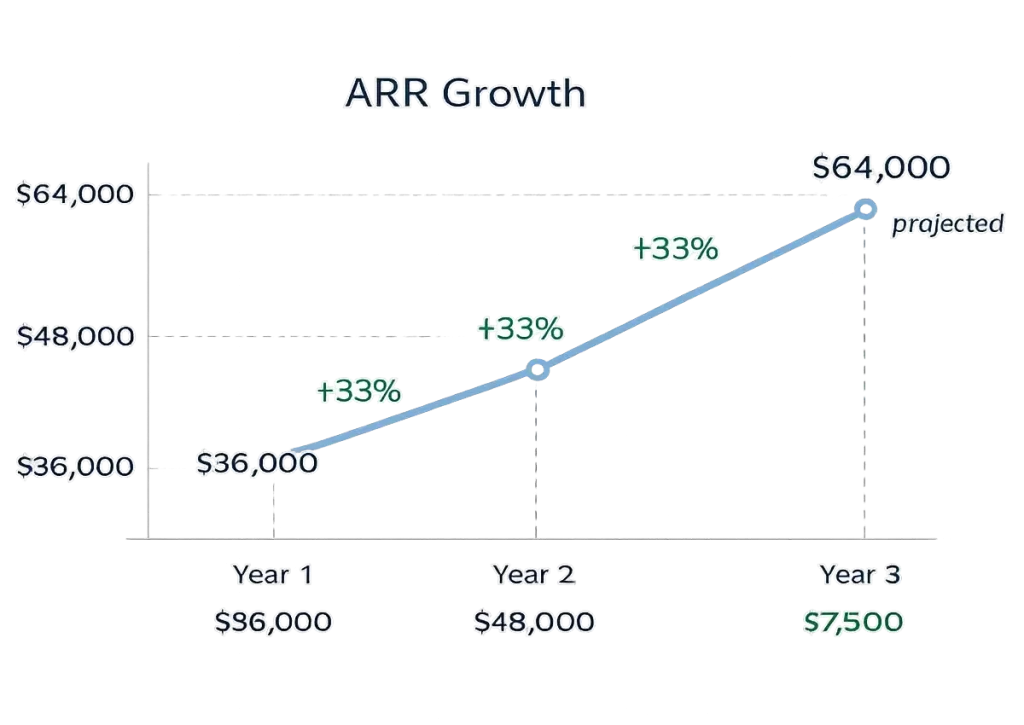
Let’s say Priya runs a language learning membership site. Last January, her ARR was $36,000. This January, it’s $48,000.
Her ARR growth rate: (($48,000 – $36,000) / $36,000) × 100 = 33.3%
That’s strong growth. Priya’s business is moving in the right direction.
Common Mistakes
Confusing ARR with annual revenue. ARR is only recurring subscription revenue. If you sold $5,000 worth of one-time courses last year, that doesn’t count toward ARR. Keep them separate.
Forgetting to normalize monthly subscribers. If you only count annual subscribers in your ARR calculation, you’re missing a huge chunk of your recurring revenue. Monthly subscribers absolutely count. Multiply their MRR contribution by 12.
Double counting annual payments. When someone pays $200 upfront for an annual subscription, it’s tempting to feel like you have $200 more this month. But for ARR purposes, that $200 is spread across the year. Don’t inflate your ARR by counting annual payments multiple times.
Ignoring ARR churn. Your ARR isn’t static. Members cancel. Annual subscribers don’t renew. If you’re not tracking how much ARR you’re losing alongside how much you’re gaining, you’re only seeing half the picture. This connects directly to your churn rate.
Overcomplicating it. Some site owners get lost trying to calculate ARR with perfect precision, accounting for every proration and partial month. For most WordPress membership sites, MRR × 12 is accurate enough. Don’t let perfect be the enemy of good.
Real World Benchmarks
What’s a good ARR for a WordPress membership site? It varies wildly based on niche, pricing, and audience size. But here are some reference points:
- Side project level: $5,000-20,000 ARR
- Full-time creator income: $50,000-100,000 ARR
- Established membership business: $100,000-500,000 ARR
- Major players like Copyblogger or Smart Passive Income: $1,000,000+ ARR
No need to feel sad if your ARR seems small compared to the big names. Every successful membership site started at zero. Pat Flynn didn’t wake up one day with a million-dollar ARR. He built it over years, one subscriber at a time.
The goal isn’t to hit some arbitrary number. It’s to grow consistently and sustainably. A 20% year-over-year ARR growth rate puts you ahead of most businesses.
Track Your ARR Automatically
Calculating ARR by hand is manageable when you have one membership tier and a handful of subscribers. But when you’ve got multiple plans, a mix of monthly and annual billing, and hundreds of members across MemberPress or Paid Memberships Pro, the math gets tedious fast.
We built Sad Subscription Analytics to handle this for you. It connects to your payment provider, pulls in your subscription data, and calculates both MRR and ARR automatically. You’ll see exactly where your business stands without wrestling with spreadsheets.
Because knowing your ARR is the first step to growing it. And growing it is the first step to making your subscription metrics a lot less sad.